How to Get Paid as a Freelancer
By Miguel Silva Published
Key takeaways
- Agree the money and the dates before you start, invoice the day you finish, and nudge the morning after it's due. None of it is clever, and all of it works.
- Bank transfer is the cheapest way to take money from a direct client, and it's where I'd start. Cards and PayPal get you paid faster and take a few percent for the trouble.
- A quarter to half upfront is normal for project work with a new client, and asking early tells you a lot about how the rest of the job is going to go.
- Write the real date on the invoice. Leave it at "Net 30" and you and your client will quietly count from different days.
- Most invoices that never get paid were never actually refused. Nobody was watching them, and by the time you notice, bringing it up feels awkward.
Getting paid as a freelancer comes down to four habits, and none of them are clever. You agree what you're charging and when it's due before you start. You take a deposit, if that's normal in your line of work. You send the invoice the day you finish, not the next time you sit down to do admin. And you follow up the morning after the due date rather than three weeks later.
That's the whole list, which is sort of the problem, because it goes wrong constantly anyway. Nobody goes freelance because they were excited about invoicing. You went for the work, and the work turned up with a second job stapled to it: quoting, chasing, and drafting your fourth polite email about money somebody already agreed to pay you.
Every freelancer I've talked to about this already knew the list. They also had a client six weeks late and an invoice from March they were becoming fairly sure they never actually sent.
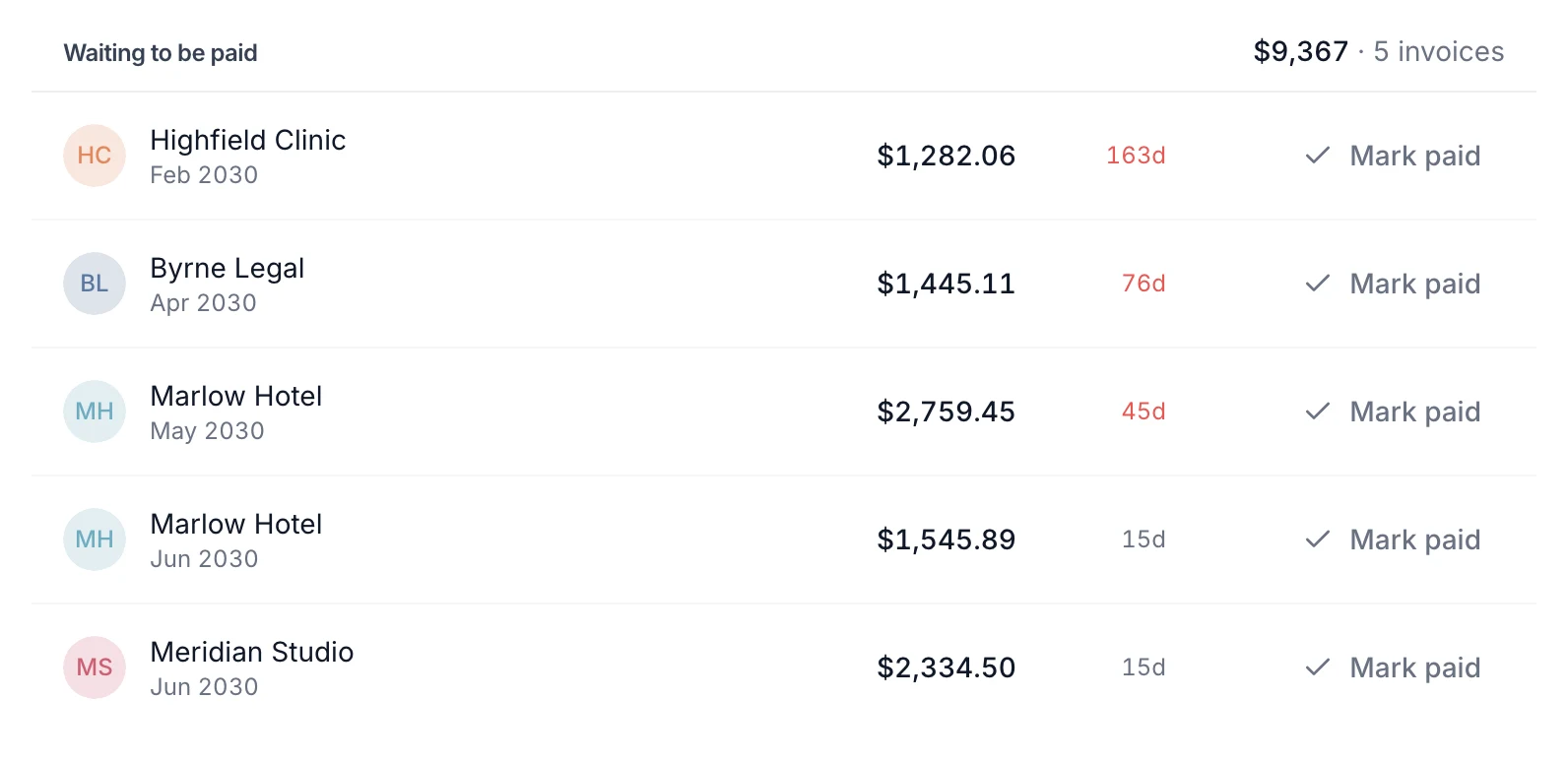
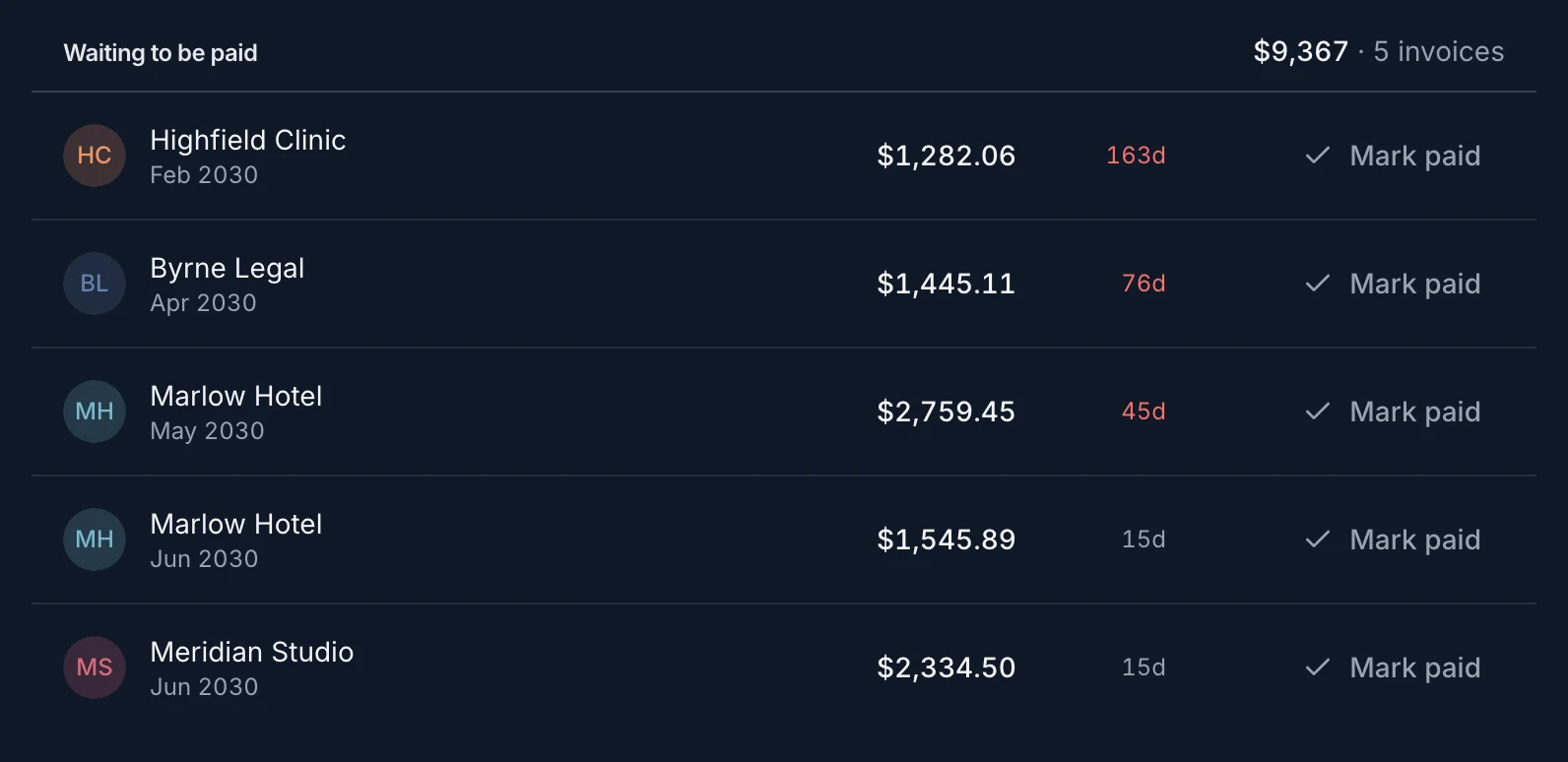
So the problem isn't knowing what to do. Getting paid as a freelancer falls over at that last step. Following up means being aware, on an ordinary Tuesday in a week where three other things are on fire, that one invoice went past due yesterday and that the job you wrapped in May never got billed at all. Nobody carries that around in their head. It has to live somewhere, and that somewhere can be a spreadsheet or a client payment tracker.
How do freelancers actually get paid?
Bank transfer, usually. It shifts around by country and by what your clients are already used to, but the shape stays the same: when you're working with clients directly rather than through a platform, you send an invoice with your account details on it, and some number of days later the money turns up. Cards, payment links, PayPal and the instant bank apps all work fine too. They're faster. They also take a percentage of every invoice, so what you're really buying there is speed.
| Method | What it costs | Worth knowing |
|---|---|---|
| Bank transfer | Little or nothing at home. Abroad, a wire fee plus your bank's exchange-rate markup | Works for direct client work of any size, and there's nothing to set up on either side. Somebody at their end still has to sit down and actually pay it, so on its own it does nothing for you |
| Card or payment link | Stripe takes 2.9% plus 30 cents on a US card, another 1.5% if the card is foreign, plus 1% if it needs converting | For clients who'd rather pay straight from the invoice. Genuinely saves days, because nobody has to schedule anything. On a $4,000 US card payment it's about $116, so do the sum before you offer it |
| PayPal | 2.99% on a card, 3.49% via PayPal Checkout and 4.99% on Pay Later, all plus 49 cents in the US, another 1.5% from abroad, and a conversion spread on top | Good for overseas clients and smaller jobs. Its real advantage is that everybody already has one, so use a business or invoicing flow, not friends and family |
| Instant bank apps (Zelle in the US, and local equivalents) | Usually free | Quick and cheap for small domestic jobs. But Zelle is US-only, payments can't be reversed, and there's no purchase protection behind you. Fine for a client you know well, less so for a first job |
| Multi-currency account (Wise and similar) | Conversion from 0.57%. Receiving domestic payments in 9 currencies is free, and account details covering 22 currencies is a one-time $31 | For clients in another country. You get local account details in several currencies, so from their side it's just an ordinary domestic payment. Letting your own bank do the conversion instead is the financial version of changing money at the airport |
| Platform escrow (Upwork, Fiverr) | Upwork's freelancer fee is 0% to 15% per contract, fixed before you accept. It isn't the flat 10% you'll still see quoted everywhere | For clients you've no way to check out. The money is funded before you start, which nothing else here gives you. Check the milestone actually says "Funded" before you do any work |
Pick whichever suits you, honestly. What I would not skip is putting your default and a backup on every single invoice. If a client has to email you to ask how to pay, that invoice sits there another three days, and you've lost most of a week to a missing account number. Same goes for the fees on an international payment: settle who's covering them before you send the invoice, not after, because they get big enough to be worth arguing about and nobody enjoys that conversation in reverse.
Keep it in perspective, though. None of this decides whether you get paid. Making it easy helps a bit, and a one-click link does take away an excuse. But a client who means to pay you will manage a bank transfer.
Should you ask for money upfront?
If it's project work and you've never worked with this client before, yes.
I'd ask for half. Maybe that's more than you're comfortable with on a first job, and a quarter is perfectly normal too. What isn't normal is nothing. And asking out loud is nowhere near as bad as it is in your head, where you've rehearsed it forty times and it has gone badly in most of them. Your client has put a deposit down on a rental car before. They'll cope.
The obvious reason is cash flow. You're not funding somebody else's project out of your own account for six weeks. The better reason is what the answer tells you: a brand new client who won't put anything down at all is a thing you want to find out now, not after the work is done and you're refreshing your banking app for the ninth time this morning.
You can just say it in the conversation where you agree the price:
Happy to get started. I usually work on 50% upfront and 50% on delivery, so I'll send the deposit invoice over today and we can kick off as soon as it lands.
If the wording is the bit you stall on, how to ask a client for upfront payment goes through it properly: when in the conversation to raise it, how much to ask for, and what to say when the answer is no.
Two honest caveats. That 25 to 50% range gets repeated everywhere, so I went looking for the survey behind it, and there isn't one. Treat it as the range nobody blinks at, not a standard you can quote at someone. And it doesn't apply everywhere. Plenty of larger companies genuinely can't pay a penny before delivery, however much your contact wishes they could. If that's your situation, bill long projects in stages and keep a new client's first job small. You're protecting the same thing either way: nobody should end up holding months of your unpaid work.
What payment terms should you set?
The shortest ones your clients will actually accept, agreed before you start, with the real due date written on the invoice. That last bit matters more than which term you pick.
| Term | What it means | Where it fits |
|---|---|---|
| Due on receipt | Pay it when you get it. A payment term, and a small act of optimism | Small jobs, repeat clients you trust |
| Net 7 / Net 14 | 7 or 14 days from the invoice date | Direct client project work, and a sensible default |
| Net 30 | 30 days from the invoice date | Anywhere there's a finance department, and most agencies |
| Net 60 / Net 90 | 60 or 90 days | Large companies and some media clients. Push back, and price it in if you can't |
| Payment within X days of month end | You go into their monthly run | Common across Europe. Ask which run you make, because missing it by a day costs you a month |
Whichever one you land on, say it early. When your terms come up in the same conversation as the price, nobody thinks twice about them, because they're part of the deal like everything else you just agreed to. Leave it, and the client meets them for the first time on the final invoice, where they read as a request, and requests are easy to put off until next month. So get the mildly awkward sentence out of the way while you're both still talking about money anyway.
Some wording you can steal. Terms only work if the client saw them before the work started, so these are short enough to drop into a quote, a contract, or the footer of an invoice.
On the quote or proposal: Payment terms: 50% deposit to confirm the booking, balance due within 14 days of the final invoice date.
On the invoice: Payment due within 14 days of the invoice date. Due August 13, 2026.
If you charge for lateness: Invoices unpaid more than 14 days after the due date accrue interest at 1.5% per month on the outstanding balance.
For staged or split payments: This project is billed in two parts: 50% due before work begins, 50% due within 14 days of delivery.
If you want a late-payment clause, put it in the quote. A fee nobody agreed to, sprung on an overdue invoice weeks later, reads as a punishment, and now you're arguing about two things instead of one. Write the due date out in full as well, the way it is above, rather than leaving "Net 14" for whoever opens the email to count. A surprising amount of late payment is really just two people counting from different days. Our free invoice due date calculator will do the counting if you'd rather not.
When should you send the invoice?
The day you finish. Not at the end of the month, not the next time you sit down to do your admin, and definitely not once you've stopped feeling weird about it.
It's easy to lose sight of the fact that the clock doesn't start until the invoice lands. Net 14 sent twelve days after you finished is really Net 26, and you handed over those twelve days yourself.
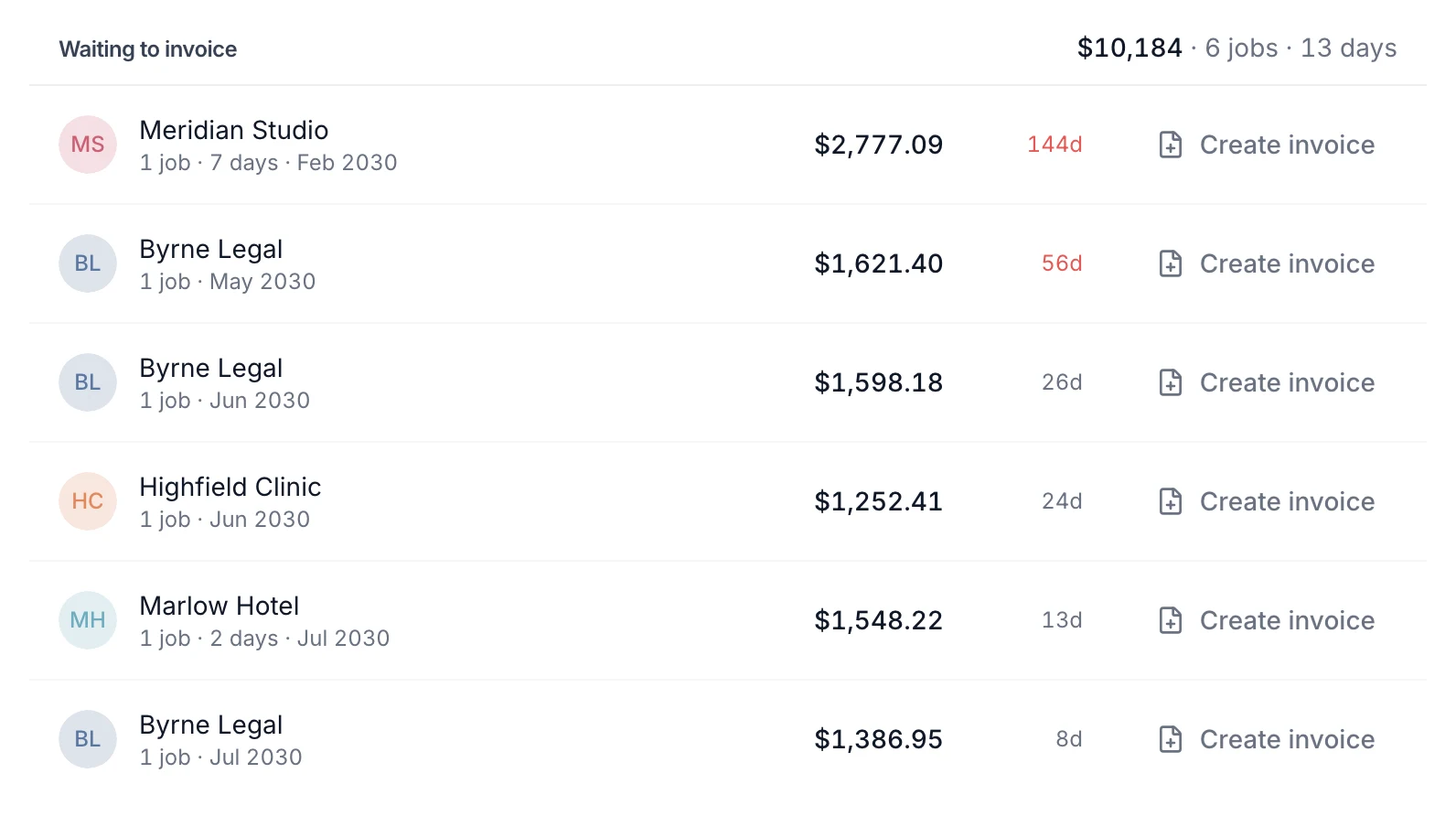
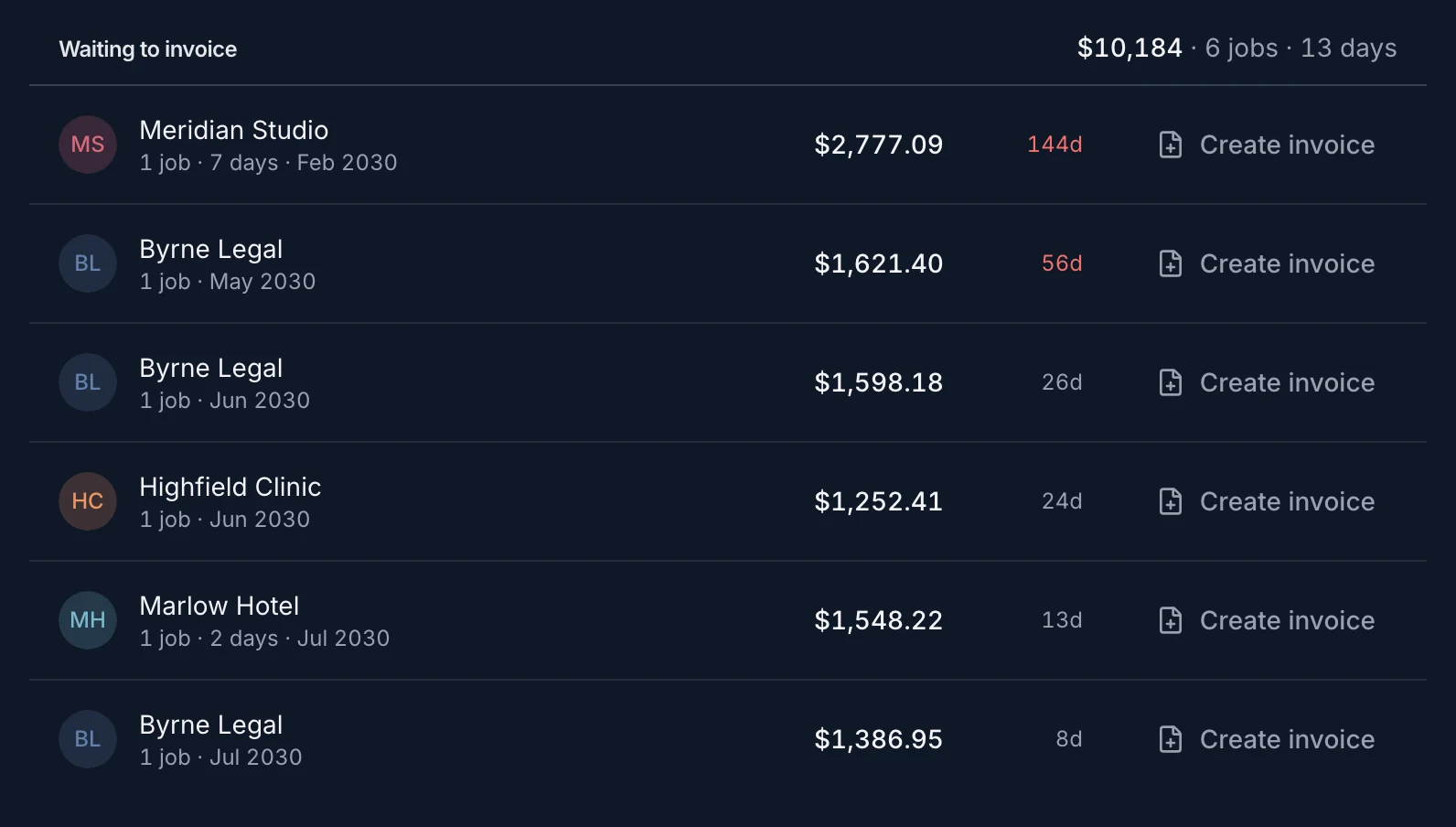
The worse version isn't the invoice you sent late, though. It's the one you never sent at all. The job wrapped in a busy week, it dropped out of your head, and nothing anywhere is keeping a note that the money is still owed. So nobody chases it, you included, because as far as your records are concerned it was never owed in the first place. I wish I could tell you that one's rare.
Whatever you make invoices in, a document template or actual invoicing software, get these six things onto it so nobody has to email you a question before they can pay:
- An invoice number, because their accounts team is going to ask for it
- The invoice date and the due date, both as real dates
- The amount and the currency
- One line saying what it's for, matching what they agreed to
- Your payment details in full
- Their PO or reference number, if they work that way
Leave one off and what comes back is a question instead of a payment, and those days are just gone.
What do you do when a payment is late?
Send a short, friendly note the first day it's overdue. Then again around day 7, and again around day 14, each one a little firmer than the last, and pick up the phone somewhere around day 21. Decide those days now, while you're calm, so you're not deciding them later, in a worse mood, at 11pm.
- Day 1 overdue. A quick nudge with the invoice attached, on the assumption it got buried.
- Day 7. Ask for a specific date the payment is going out.
- Day 14. Firmer: new work on hold, plus the late fee if you agreed one.
- Day 21 and past it. A phone call, then a final written notice with a date on it.
Day one is shorter than you'd think:
Hi Tom, quick one: invoice 022 for 1,450 was due on Monday. I've attached it again in case it got lost in the shuffle. Any idea when it's likely to go out?
There's no apology in it, nothing accusing, and it's deliberately not an essay. You're handing someone an easy way to fix an oversight, and most of the time that's genuinely all it is. You don't need a lawyer here. You need a calendar reminder and slightly less shame.
Our guide on how to get clients to pay on time walks through the full cadence and how to stay friendly the whole way through. And if the day one nudge above is useful, how to ask a client for payment has one more like it for every stage after, right through to a final notice.
And it usually is an oversight. Bonsai went through three years of invoicing data from its user base of more than 100,000 freelancers and found 29% of invoices were paid after they were due. More than three quarters of those still landed within two weeks of the due date. Xero, looking at more than 32,000 US small businesses, put the average at 8.5 days late for the June 2026 quarter. Very little of that is about you. It's an invoice sitting in the wrong inbox, or a company that pays everything in one run on the 25th and you missed it by a day, or a client with cash flow trouble of their own.
If the cadence runs all the way out, you usually have more standing than you'd expect, even with no late-payment clause. In the UK, late commercial payments carry statutory interest of 8% over the Bank of England base rate, which comes to 11.75% as of mid-2026. In the EU, the late payment directive makes a B2B invoice due in 30 days when nobody agreed a date, entitles you to at least eight points over the reference rate, and adds a minimum 40 euro towards your costs that's owed to you without having to send a reminder first.
The US has no federal version, so it comes down to your contract and where you are. Freelancer-specific laws are spreading, though. New York City and New York State both require a written contract at $800 or more from one client in 120 days, and let you claim double what you're owed plus legal fees. Illinois does the same at $500, California has covered the whole state since January 2025 at just $250, and Los Angeles adds a $600 rule per calendar year. In California and LA the doubling is a ceiling a judge can award, not something automatic.
Past that it's a formal demand letter, small claims if the amount fits, or a collections service as a last resort. That's deliberately the short version. Genuine non-payment is a topic of its own, and thankfully rare. If you're sitting in it right now, what to do when a freelance client won't pay picks up from here: telling ordinary slowness from real silence, what to send once they've stopped replying, and how to decide between escalating and writing it off.
How do you keep track of what you're owed?
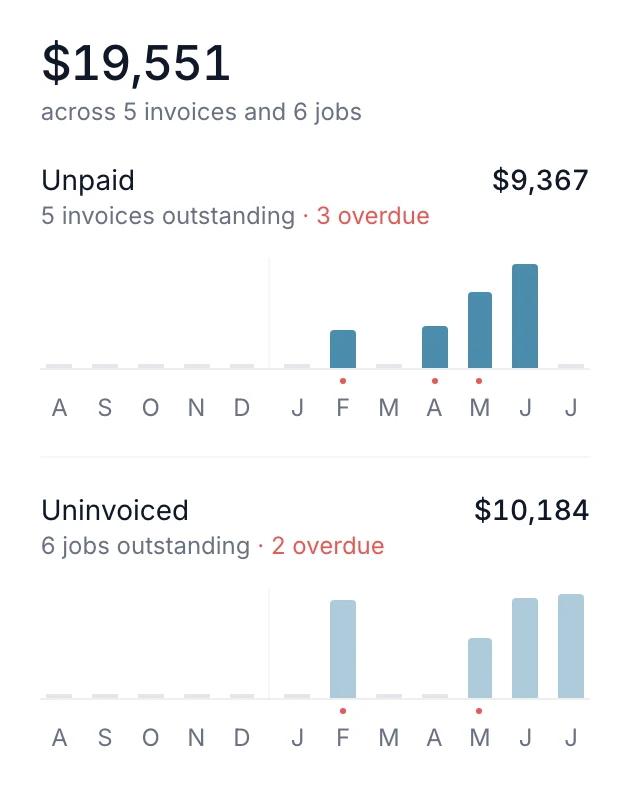
One place that tells you who owes you money, how much there is altogether, and how late the worst one is. Then actually open it once a week.
Everything else on this page rests on that, which is why it's a bit odd that most guides about getting paid walk straight past it. Your terms do nothing if nobody notices the date going by, and the best-worded reminder in the world doesn't get sent if the invoice isn't on a list somewhere. When a freelancer follows up three weeks late, it's hardly ever nerves. Tuesday came and went and nothing told them.
The free version is a spreadsheet with a row per invoice, a due date and a status column. Our free invoice tracker template is exactly that, and the overdue rows go red on their own. For five or six live invoices, that's honestly all you need.
One thing to get right whatever you use: keep both halves of what you're owed in it. Everybody tracks the invoices they've sent and not been paid for. The half that goes missing is the work you finished and never invoiced, and it's often the bigger number of the two.
The hard part isn't the list
So: sort out the money and the timing before you start, take a deposit where that's normal, invoice on the day you finish, and follow up the morning after the due date. Keep one honest list of what you're owed, with the unbilled work in it too. You can do every bit of that in a spreadsheet, for free, and it works.
Most of that is a one-off effort. Terms you agreed once keep being agreed, and a due date you wrote out in full stays written. The watching is the part that isn't. It has to keep happening through the weeks when you're flat out and opening a tracker is the last thing you feel like doing, and those are exactly the weeks an invoice goes missing.
That's the part Tideplan carries for you. The overdue invoices and the finished work you haven't billed are on the screen when you open it, so staying on top of the money doesn't depend on you being organized on your worst week.