How to Get Clients to Pay on Time
By Miguel Silva Published
Key takeaways
- Almost nobody pays late to spite you, they're just disorganized. The client lost the invoice, the approver was on holiday, or the invoice never went out at all.
- You can't chase what you can't see. Knowing who's overdue today is what makes all the other tactics land.
- Set expectations before the work starts, put a real calendar date on every invoice, and send it the day the work is done.
- Decide your reminder days once (day 1 overdue, day 7, day 14) and send them on schedule. Three short nudges beat one angry email on day 40.
- Keep reminders short, factual, and friendly, and attach the invoice every single time.
Chasing payments might be the worst part of freelancing. The work went well, the client said thanks, and three weeks later you're staring at a draft of your fourth "just checking in" email, wondering if it's too soon to send it. It isn't. Honestly, it wasn't too soon two emails ago.
Here's the thing about how to get clients to pay on time: it's a systems problem, not a personality problem. You don't need to become scarier, and you don't need the perfectly worded guilt trip. You need clear terms before the work starts, invoices that go out the day the work is done, follow-ups that run on a schedule instead of a mood, and, underneath all of it, one place that shows who owes you what right now, whether that's a spreadsheet or a client payment tracker. I've watched this play out with enough freelancers now that the pattern is hard to miss: the fix is almost never a better email, it's a better system.
How do you get clients to pay on time?
Seven tactics, in the order they pay off:
- Know who is overdue before you chase. Keep one place that shows every invoice, its due date, and its status today. You can't follow up on an invoice you've lost track of.
- Agree payment terms before the work starts. Terms, deposit, and late-fee policy belong in the conversation where you agree the price, not on the final invoice.
- Invoice the moment the work is done. Every day between "finished" and "invoiced" is a day you added to your own payment delay.
- Put a real date on the invoice. "Net 30" lands on a different day depending on who's counting; "due 19 August" doesn't.
- Make paying easy. Put the amount, your payment details, and one obvious way to pay right on the invoice, so nobody has to email you a question first.
- Follow up on a schedule. Decide your reminder days once (day 1 overdue, day 7, day 14) and send them when they come up, so you're not re-deciding every morning whether today's the day.
- Escalate calmly when the schedule runs out. A firmer notice, work on hold, and the late fee if you agreed one, in that order.
The rest of this guide walks through how to actually do each one.
Why do freelance clients pay late?
Mostly not because they're villains. Even the client who "forgot" three months running is usually disorganized rather than evil (usually). And late is astonishingly normal: when Bonsai analyzed three years of invoices from more than 100,000 freelancers, 29% were paid at least a day late. That's too many people to all be scheming. What's actually happening, in roughly descending order: the invoice got buried in an inbox, your contact never forwarded it to whoever approves payments, the company pays everything in one monthly run you just missed, they're juggling their own cash flow, or, occasionally, they're quietly hoping you won't push.
This matters because the fix is different. If most lateness is drift, then clear dates, reminders, and visible tracking solve most of it, and you can save the hard conversations for the rare client who's earned one. Treating every late payment as a betrayal burns energy you could spend on work someone actually pays you for.
And, uncomfortable as it is to admit, some of the delay usually lives on our side: the invoice that went out two weeks after the job ended, the "Net 30" nobody turned into a real date, the follow-up that slipped because chasing felt awkward. Totally human, and also the part you fully control, which is why that's where the tactics start.
How do you set payment terms that get paid?
The trick here is timing more than wording. Raise your terms before the work starts and they're just part of the deal. Wait until they turn up on the final invoice and they read like a polite ask, the kind that's easy to wave off. So get the slightly awkward line out early, in the same conversation where you settle the price: "Just so it's not a surprise later, my invoices are due 15 days from the invoice date." It feels uncomfortable the first couple of times you say it. It feels a lot worse to be chasing your own money in week three.
Beyond that one sentence, here's what actually helps:
- Short, explicit terms. What's normal varies by region and industry: US clients talk in Net 15 or Net 30, much of Europe writes "payment within 30 days", and in some fields the month after is just how it works. Don't fight your market's culture, just ask for the shorter end of its normal, and agree the date explicitly. Even on long terms, a date you both said out loud gives your follow-ups a day to start from.
- A deposit, if your field does deposits. For direct-to-client project work, 25-50% upfront from a new client is normal, and it filters out the ones who were never going to pay well. Where upfront just isn't done (corporate clients, mostly), bill long projects in stages and keep a new client's first project small. Either way, nobody should ever owe you months of work.
- A real due date on the invoice. Write the actual date next to the terms: "Due 19 August 2026." So much late payment is really just two people counting from different days, and a date spelled out in full leaves nothing to argue about. If counting isn't your idea of fun, our invoice due date calculator does it for you.
- Put everything they need to pay on the invoice. Amount, currency, your payment details, the invoice number their accountant is going to ask for anyway. Leave one of those off and they have to email you before they can pay, and that back-and-forth is just more days the invoice sits there.
- Send it the day the work is done. The longer you sit on an invoice, the more the client reads its deadline as optional, and honestly, they're not wrong to. But the one that really costs you is the invoice you forget to send. That job doesn't get paid late, it just never gets paid.
When should you follow up on an invoice?
On a schedule you decided while calm, not whenever the frustration boils over. The magic of a cadence is that it ends the daily negotiation with yourself about whether today's the day you say something. You already decided. Today is day 7, so the day 7 email goes out. No feelings required.
Here's a starting cadence that works for most freelancers. Shift the days to fit your terms, your client, and what's normal where you both work. A corporate client on 60-day terms may need to be chased differently than a small local one.
| When | What you send | Tone |
|---|---|---|
| 1-2 days before due | Optional heads-up that the invoice is coming due | Friendly |
| Day 1 overdue | Short reminder, invoice attached | Friendly, assumes oversight |
| Day 7 | Follow-up asking for a concrete payment date | Polite but direct |
| Day 14 | Firmer note: new work paused, late fee if agreed | Firm, professional |
| Day 21+ | Phone call, then a final written notice | Formal |
Two things make it work. It starts on day 1, not day 20. A nudge the morning after the due date just reads as "hey, I noticed," and most honest slip-ups get sorted within the week. And because each step is only a little firmer than the last, you never jump from saying nothing to firing off an angry email. The calendar handles the escalating for you, so you get to stay friendly the whole way through.
How do you know who is overdue?
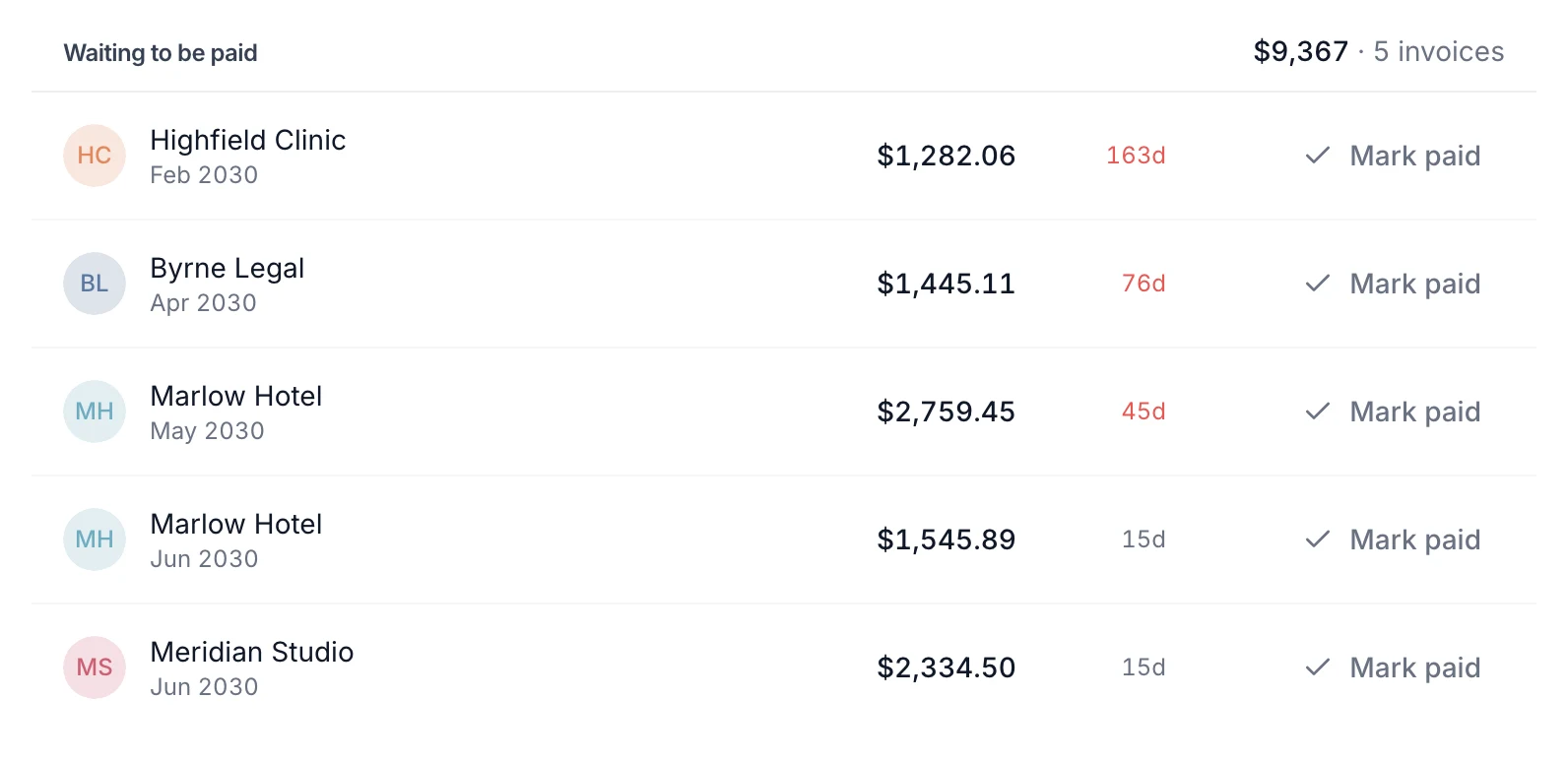
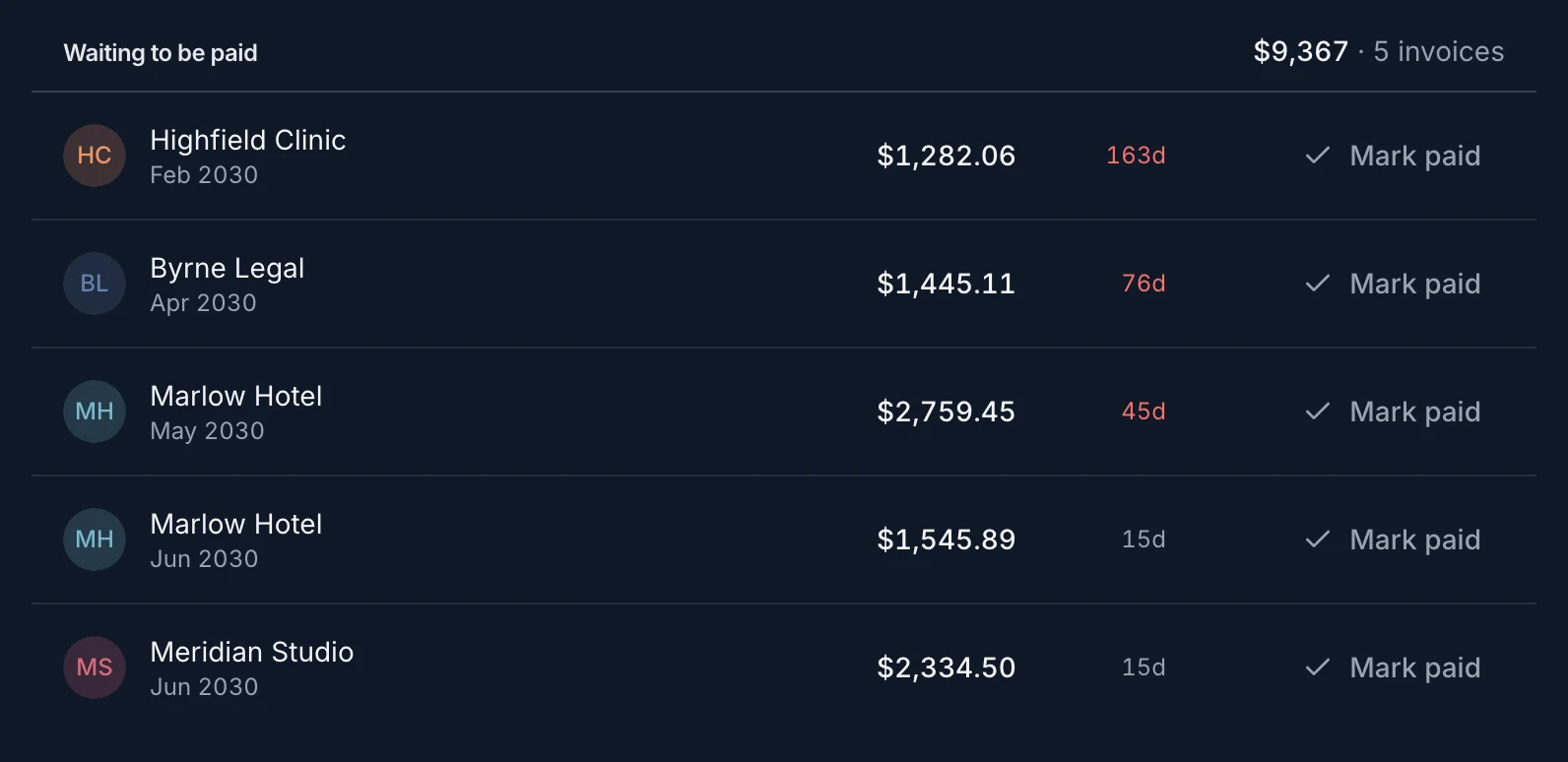
This is the question almost every "chase your clients" guide skips, and honestly it's the reason I wrote this one. Most freelancers don't follow up late because they're timid. They follow up late because they didn't know. The invoice lives in a sent folder, the due date lives in your head, and somewhere in the middle of a busy month a client slides three weeks overdue without a single alarm going off. You can't chase what you can't see. It's the same story I kept seeing freelancers hit, over and over, and it's the problem Tideplan exists to fix.
The one thing everything else depends on is gloriously boring: one place that answers, at a glance, who owes you money, how much, and how long past due. The minimum viable version is a spreadsheet with a row per invoice and a status column. Our free invoice tracker template is exactly that, overdue rows flag themselves red, and for a handful of invoices it's genuinely enough.
Whatever you use, make it catch the other leak too: finished work you never invoiced at all. Every completed job should have an invoice attached, or a loud reason why not. It's the least glamorous number in freelancing and routinely the most expensive one.
What should a payment reminder say?
Less than you think. The reminders that get invoices paid are short, factual, and friendly, because the real message isn't the words, it's the fact of the email: someone is tracking this. Name the invoice number and amount, state the due date, attach the invoice again, ask one clear question, done.
Day 1 overdue looks like this:
Hi Anna, just a nudge that invoice 014 (1,200) was due yesterday. I've attached it again in case it got buried. Could you let me know when it's scheduled? Thanks!
Day 14 looks like this:
Hi Anna, following up on invoice 014 (1,200), now two weeks past its 19 August due date, previous reminders on the 20th and 27th. Could you confirm payment this week? I'll have to pause the remaining work on the project until it's settled.
None of these are apologetic. No "sorry to bother you", no long explanation, no guilt trip. You don't need to get angrier as the days pass, either. The day 14 note isn't a louder version of day 1, it just carries a bit more history and one clear consequence. And when email goes quiet, a short phone call around day 21 beats firing off a fifth message, because a real voice is much harder to ignore.
What if a client still doesn't pay?
Sometimes the cadence runs out, and I'm not going to make light of it: not getting paid for finished work is genuinely awful, often a real financial hit. So take it seriously. Escalate one step at a time instead of all at once: a final written notice with a firm date, all work for that client on hold, and any late fee or interest you're owed. A lot of places back you up here even without a contract. In the UK, late commercial payments carry statutory interest of 8% plus the Bank of England base rate. In the US it varies by state, but in New York the Freelance Isn't Free Act can get you double what you're owed plus legal fees.
Past that firm date, the usual routes are a formal demand letter, small claims court if the amount fits, or a collections service as a last resort, each one worth weighing before you commit. That's the short version on purpose. Real non-payment is its own big topic, and thankfully it's rare. The whole point of the seven tactics above is that you almost never end up here.
Paying on time starts with seeing on time
None of this asks you to turn into a scarier version of yourself. Agree the terms up front, send the invoice the day you finish with a real date on it, start following up on day 1, and keep one honest view of who owes you what. Run that on a spreadsheet and it genuinely works.
The catch is that it only works if someone checks it every single week, forever, and the weeks that slip are the busy ones, which are exactly when invoices drift. That's the part I built Tideplan to carry: it keeps an eye on the due dates and the work you haven't billed yet, so the checking still happens when your week gets loud. Getting clients to pay on time stops being one more thing to remember and turns into a five-minute Friday habit.