What to Do When a Freelance Client Won't Pay
By Miguel Silva Published
Key takeaways
- Replies tell you more than the calendar does. Two unanswered follow-ups is its own problem.
- Once they've gone quiet, stop nudging and send one dated summary with a deadline on it.
- Pause the work, and say out loud that you're pausing it.
- A late fee only works if you agreed it before the job started.
- Whether to escalate is arithmetic: the amount, the evidence, and whether they can actually pay.
There's a particular kind of quiet that an unpaid invoice makes. You sent it. You nudged on day one, followed up a week later, wrote something firmer after that, and now there's nothing coming back at all. No "sorry, next week", no excuse you could at least go and check. Just an inbox that keeps having nothing in it for you.
By this point most people sit down to write a better email. I'd stop writing emails. What moves things along from here is duller: one short, dated message setting out what's owed and what you've already sent, with a real deadline on it, then a calm decision about whether this is worth chasing or worth letting go. Almost everything written on this subject skips straight to lawyers and collections agencies. You're nowhere near either, and the boring bit in the middle is where most of these actually get paid.
This page picks up where following up runs out. If you're not there yet, and "not there yet" is most people, how to ask a client for payment has the wording for every stage before this one, and how to get clients to pay on time covers the schedule those messages run on. What follows assumes you've done all that and it hasn't worked.
Is this normal silence, or are you being ignored?
Look at replies rather than days. A client who answers slowly, vaguely, even annoyingly, is still in the conversation, and nearly all of them pay in the end. A client who's ignored two follow-ups in a row has walked out of the conversation, and that needs a different email than the one you keep rewriting.
It helps to know how ordinary the first version is. Atradius surveys thousands of businesses on how they actually pay each other, and in its 2025 North America barometer 43% of US B2B credit sales were overdue. That's nearly half of everything sold on credit, and those are companies with finance teams whose actual job is paying on time.
So being past due tells you very little by itself, which is why the "am I being ripped off" panic on day 15 is usually aimed at the wrong thing.
Here's what I'd actually look at:
| Signal | Still ordinary | Actually being ignored |
|---|---|---|
| Replies | Short, slow, but they arrive | Nothing back on two or more follow-ups |
| Reasons | A specific one you could verify ("you missed the 25th run") | None at all, or a new one every time |
| Other channels | Still answering you about the work itself | Quiet everywhere, including the project thread |
| Time past due | Days to a couple of weeks | A month or more with no contact |
| History | Always slow, always pays | First time this client has gone dark |
Two things worth remembering before you assume the worst. A read receipt isn't an answer, but it isn't a snub either. People open an email fully meaning to deal with it later, and then the day happens to them. And the person you talk to every day usually isn't the person who pays. Plenty of what looks like a client dodging an invoice is one designer forwarding it to one finance inbox, and then both of them getting on with their week.
What do you send when they've stopped replying?
One message, and its job is to be a record. A fifth version of the nudge has the same problem the four before it had: they've read that email and decided not to act on it, and rewriting it doesn't change what it is. What's different this time is that you're putting the whole thing down in writing, with dates, and handing them a date to answer by.
Three things, and the order matters.
Make sure it's even reaching someone who can pay it. Before you escalate anything, forward the invoice directly to whoever handles payments, or to the accounts inbox listed on the original purchase order, and copy your usual contact. A surprising number of dead invoices are dead because they never left one person's inbox. Costs you nothing, and every so often that's the entire story.
Subject: Invoice 042, unpaid since August 14
Hi Sam, copying in accounts directly in case this hasn't reached them. Invoice 042 for $1,800 has been outstanding since August 14. Could someone confirm it's in the system and when it's scheduled? Attaching it again here.
Send one written summary with the dates in it. This is the message that matters. Plain, unemotional, specific enough that whoever reads it later (their finance director, a mediator, a judge, you in three months) can follow what happened without you narrating it. No threats, no feelings, just a timeline and one ask.
Subject: Invoice 042: outstanding 45 days, response needed
Hi Sam, writing to summarize where this stands. Invoice 042 for $1,800 was issued on July 31 and was due on August 14. I followed up on August 15, August 21, August 28, and September 4, and haven't had a response to any of them.
The work it covers was delivered on July 30 and signed off by you the same day. Could you confirm by September 26 either that payment is scheduled, or what's holding it up? If I don't hear anything by then, I'll assume the invoice is disputed and take it from there.
Then say what happens next, if you mean it. "I'll take it from there" is deliberately mild, and mild is fine here. If you're ready to send a formal demand or file a claim, save that for the following message, and then send it. A deadline that comes and goes with nothing behind it is worse than no deadline at all, because you've just taught this client that your dates are decorative. And deciding you won't escalate is a perfectly reasonable call. Just don't spend the threat.
Keep everything in writing from here. You're probably not building a case. But if it ever turns into one, five dated emails put you in an enormously better position than a clear memory of roughly what you sent.
Should you stop work when a client won't pay?
Yes, as soon as an invoice is past due and a follow-up has gone unanswered, and say out loud that you're doing it. Pausing is normal, it's what any business does, and it's the one bit of leverage that costs you nothing to use.
Stopping quietly is what gets you into trouble. If you just slow down and go quiet back at them, there are now two people in this who aren't answering emails, and you can guess which one gets described that way later. Say it in a sentence and move on:
Hi Sam, I've put the remaining work on hold until invoice 042 is settled. Happy to pick straight back up the day it clears, everything's ready to go on my end.
Where it gets murky is work you've already handed over. Taking back access, disabling a site or pulling files is a much bigger step than holding off on what you haven't done yet, and whether you're entitled to comes down to your contract, specifically when ownership of the work transfers. Plenty of freelance contracts say rights transfer on full payment, which is a very useful clause to have. If yours says nothing on the subject, get advice before you act, because a client who owed you money and now says you sabotaged them is a worse spot than the one you're in today.
One more thing not to do: don't stop working for everyone else while you sort this out. Sounds obvious. It's also exactly what happens, because a client who won't pay eats the same headspace as three that do, and the week you spend drafting and redrafting one email is a week nobody's paying you for either.
Should you charge a late fee?
Only if you agreed it before the work started. A fee that shows up for the first time on an invoice that's already 45 days overdue reads as a punishment, and it hands a client who was already looking for an excuse a brand new one. You were trying to settle a date. Now you're debating whether the fee is fair, and the money hasn't moved an inch.
Agreed upfront it does work, though probably not for the reason you'd expect. The interest is trivial. What you're really buying is a due date with a consequence attached, and a client with a queue of invoices and not enough cash in the account pays the ones with consequences first. Being in the top half of somebody else's list is worth a lot more than the 1.5%.
Speaking of which: that 1.5% a month number gets quoted like it's a rule. No law sets it. It's a convention that stuck, and you're free to pick something else. What the law does have an opinion on is the ceiling, and that's different everywhere, so choose a number in the range nobody blinks at (1% to 1.5% a month is unremarkable) and check it against your local rules before it goes in a contract.
You may also be owed interest without ever having written a clause. In the UK, late commercial payments carry statutory interest of 8% over the Bank of England base rate whether or not you agreed anything. The EU late payment directive does something similar and adds a minimum 40 euro toward your recovery costs. The US has no federal equivalent, though several states now have freelancer-specific laws that go further, which our guide to getting paid as a freelancer runs through.
Honestly, at this stage the late fee is for your next client. Someone who has stopped answering emails about $1,800 is not going to be stirred into action by $27 of interest. Write the clause into your next contract and let it do its work there, which how to get clients to pay on time covers alongside the rest of your terms.
What if you never signed a contract?
You're in a weaker spot than you'd like. You're also not in the spot most people assume they're in, which is "well, that's that then." In most places a contract doesn't have to be a signed PDF to exist. An email where the client agreed the scope and the price, the invoice you sent, and the work you delivered and they accepted, together describe an agreement that somebody did not hold up their end of.
So before you decide you've got no standing, go and collect what you do have:
- The message where they agreed the work and the price, however casual
- Anything showing they received and accepted the work, including a "this looks great, thanks"
- The invoice, with its date and terms
- Every follow-up you've sent, with dates
That's a paper trail. Weaker than a signed contract, and I won't pretend the conversation is as easy without one. But most people who tell me there was nothing in writing turn out to have quite a lot in writing.
It's worth checking what your own jurisdiction hands you for free too, because this is changing quickly in freelancers' favor. A survey run by the Freelancers Union with the Authors Guild and several other trade bodies found 62% of New York freelancers had lost wages to non-payment at least once, and 91% had been paid late at some point. That research existed to argue for a law, and the law passed.
Several states now require written contracts above a fairly low value and let you claim double what you're owed. That's a short paragraph on a long topic, and the state-by-state detail sits in how to get paid as a freelancer.
When do you escalate, and when do you write it off?
This part is arithmetic, and annoyingly it has nothing to do with how angry you are. Three questions:
- Is the amount worth the hours? Filing a claim, preparing it and turning up is realistically a day or two of your time plus a fee. On $400 that's a bad trade. On $4,000 it usually isn't.
- Can you show what was agreed? See the section above. Dated emails and a delivered piece of work are enough to make your case. If it was all agreed on a call and there's nothing to point at, be honest with yourself about that before you spend a day in a courthouse finding out.
- Can they actually pay? A client who has genuinely run out of money is a different situation from one who's stalling. Chasing a company that's folding costs you the same effort and returns nothing.
If all three come out in your favor, the ladder is short and you climb it one rung at a time.
A formal demand letter is the first real step and often the last one. A single page stating what's owed, why, the amount, a firm deadline, and what you'll do if it passes. A lot of stalling ends right here, at the moment it becomes clear this isn't quietly going away.
Underneath the formality it's three paragraphs, and you already have all three:
Formal demand for payment: invoice 042
Invoice 042 for $1,800 was issued on July 31 and fell due on August 14. It is now 60 days overdue.
The work it covers was delivered on July 30 and signed off the same day. I have followed up on August 15, August 21, August 28 and September 4, and received no response.
Payment in full is due by October 10. If it has not been received by that date I will file a claim in small claims court for the amount outstanding plus costs, without further notice.
Nolo's guide to writing a demand letter is a good, free walkthrough if you want the longer version, and it makes the point that a written demand is worth sending even where a verbal one would do, because it stops anyone claiming later that you never asked.
Small claims court is the next rung, and some version of it exists nearly everywhere. The design is the same wherever you are: no lawyer needed, a modest filing fee, and a ceiling high enough to cover most freelance invoices. In the US, limits run from around $2,500 to $25,000 depending on the state. In England and Wales, anything up to £10,000 goes to the small claims track, and you can start the claim online. If you and the client sit in different EU countries, the European small claims procedure covers cross-border claims up to 5,000 euro, and it's built to be used without a lawyer too.
You've also got longer to decide than you'd think. In the US, the deadline for suing on a written contract is typically several years, five or six in most states, and it's years rather than months in most other places as well, though the exact number varies enough to be worth looking up. Please don't sit on it for five years. But nothing here has to be decided by Friday.
A collections agency is the last stop, and it's the expensive one. Commercial agencies work on contingency, taking a cut of whatever they recover, and 20% to 50% is the range you'll see quoted, with older and smaller debts at the wrong end of it. Handing over a third of an invoice hurts. It still beats a hundred percent of nothing, which is the honest comparison by that point.
And then there's the option nobody puts on the ladder at all: you write it off. It feels like losing, and I'm not going to dress that up. It's also something well-run companies do deliberately, on a schedule. In that same Atradius survey, 5% of long-overdue US invoices were written off as bad debt, and those are outfits with credit checks, finance teams and terms nobody argues with.
Sometimes the client is gone, the amount is small, and the most profitable thing you can do is close the file, tell your accountant, and put those hours into work that pays. Then never work with them again, which is the part you do get to control.
How do you make sure this doesn't happen again?
You can't, entirely. A bad client gets through every now and then, and no amount of process fixes someone who was never going to pay. What you can shrink is everything around them: how much you're exposed to at once, and how long an invoice can sit late before you notice.
A few things help more than they look like they should.
Take something upfront on new client project work. A quarter to half is unremarkable when you're working direct, and the answer you get back tells you plenty before you've started anything. Someone who flatly refuses one has just handed you information, early and cheaply. There's a whole page on how much to ask for upfront and what to say when they push back.
Keep a new client's first job small. You're going to find out how they pay eventually. Finding out on a $600 job beats finding out on a $6,000 one.
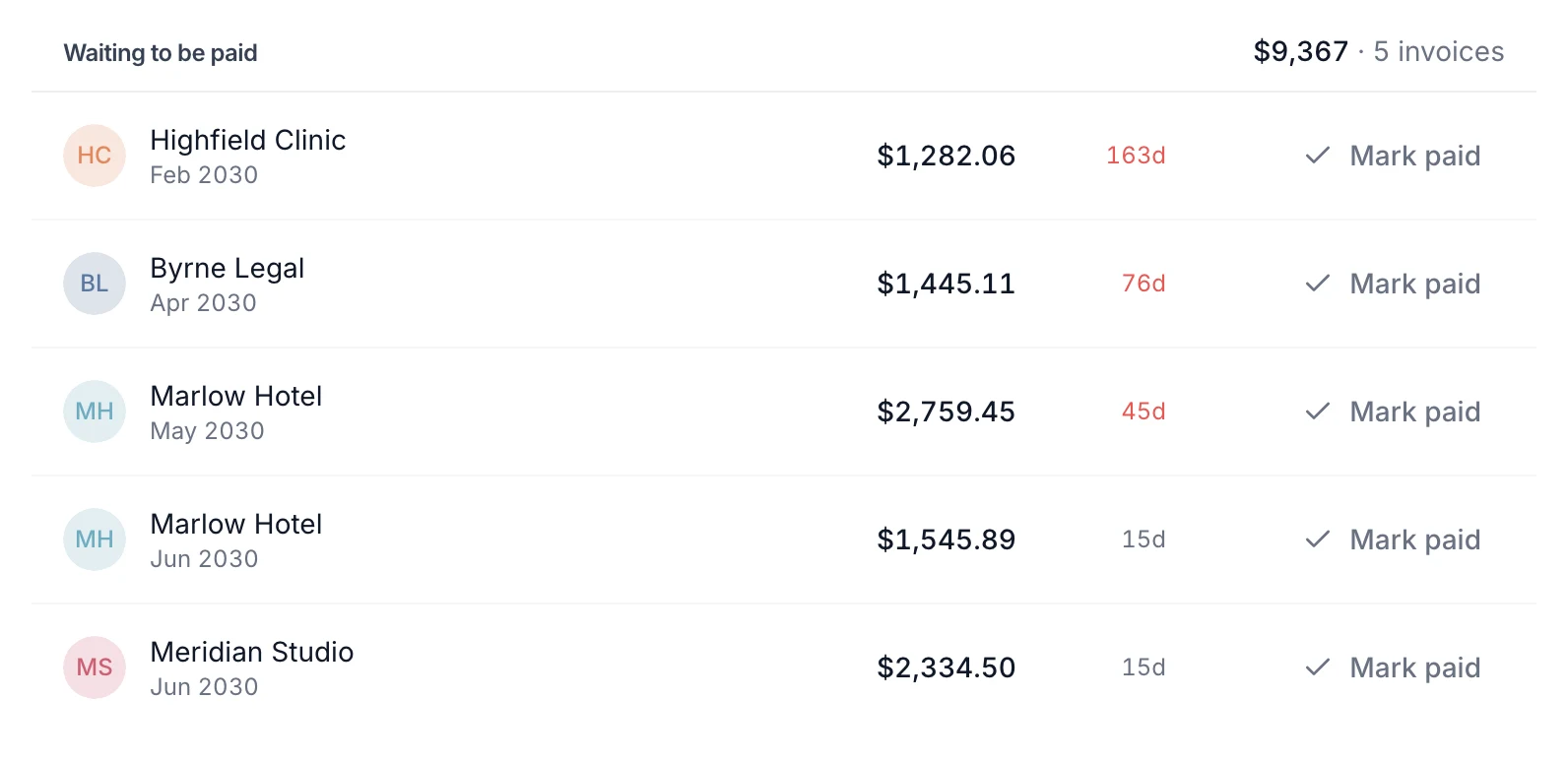
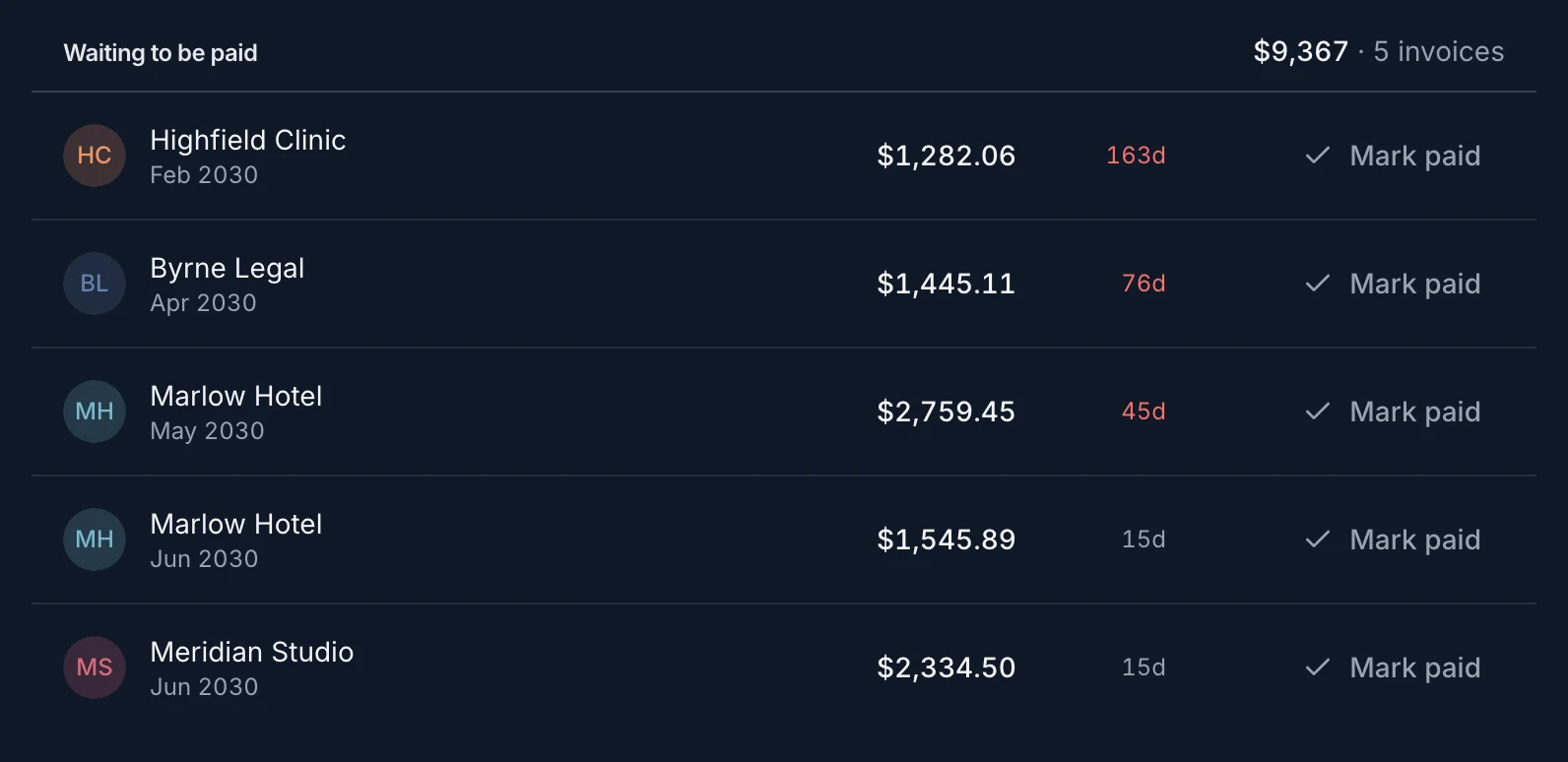
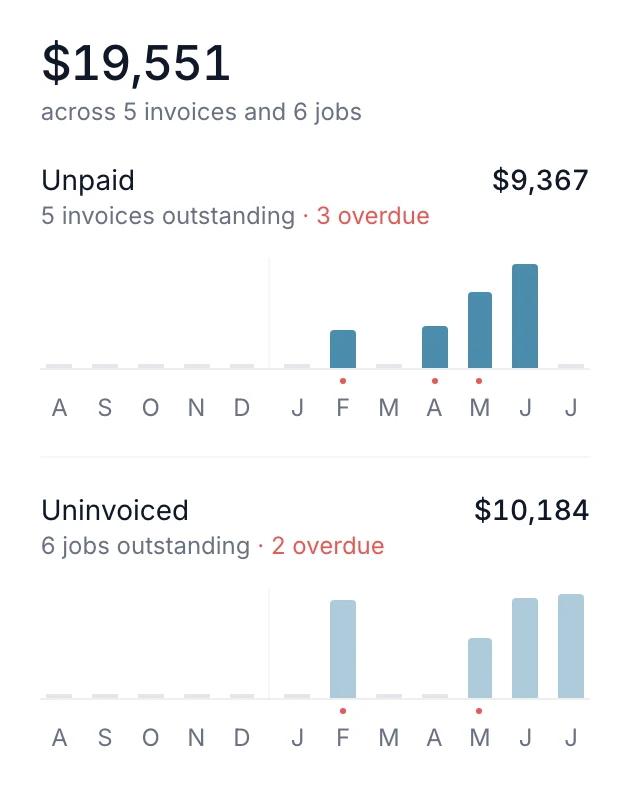
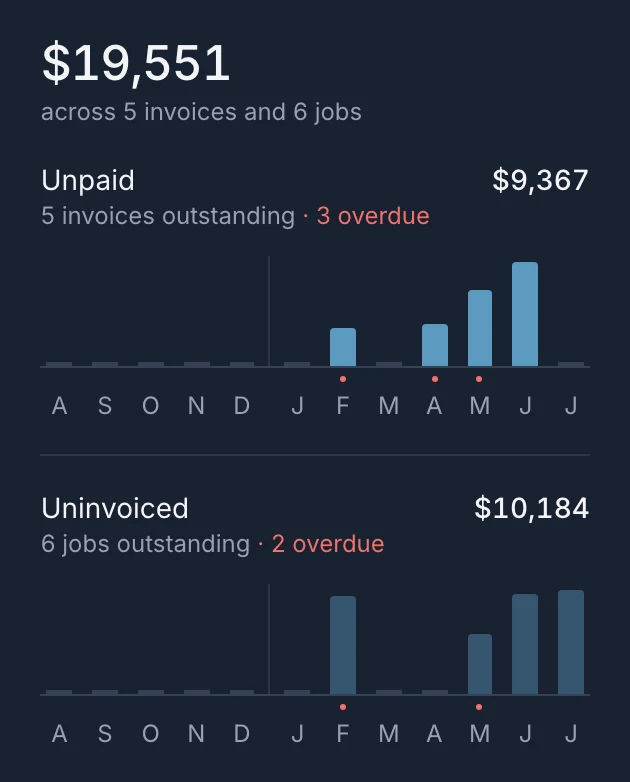
Find out on day one. This is the boring one, and it's the one that matters. Nearly every horror story in this genre has the same middle: the invoice went past due, nothing anywhere flagged it, and by the time somebody looked it was six weeks old and the conversation had gotten hard. Nothing about that invoice got worse in those six weeks. The only thing that changed was how awkward it felt to bring up, and awkwardness does grow on its own.
None of that makes a client pay you. Nothing does, in the end. What it changes is how often you land here at all, and how old the problem is when you find it, and that turns out to be most of the difference between a slightly annoying email and a genuinely bad month.