How to Ask a Client for Payment
By Miguel Silva Published
Key takeaways
- A good payment ask does four things: name the invoice, state the date, attach it again, and ask one clear question.
- Ask on day one, before the wait starts to feel like an accusation.
- Polite means specific: name the invoice, the amount, and the date.
- Save texting and phone calls for once an email's gone quiet, they get noticed faster.
- None of the wording matters if nobody notices an invoice went overdue in the first place.
You know exactly what you want to say. "Hey, you haven't paid me yet." What actually lands in the drafts folder is three tries that sound too soft to mean anything and one that sounds too sharp to send, and you sit there deciding which version makes you look the least unreasonable.
I used to think this was a wording problem. It isn't, not really. It's a permission problem, you've talked yourself into believing you need to earn the right to ask, when you're just fourteen days late noticing. The client who'd genuinely be offended by a factual, one-line nudge is rare enough that you shouldn't be writing every email to appease them. Sort the permission part out and the wording turns out to be short.
This guide covers both halves: how to sound like yourself instead of a debt collector or a doormat, and copy-paste templates for the actual moment, whether that's the day before it's due, day one overdue, or the awkward stretch three weeks in where you're wondering if you should just call. (If chasing on a schedule isn't something you've set up yet, how to get clients to pay on time covers the cadence this page's wording plugs into, and how to get paid as a freelancer has the fuller picture, terms and deposits included, if you want the whole journey rather than just this part of it.)
How do you ask a client for payment?
A good ask is short, factual, and asks one thing. Name the invoice number and the amount, say when it was due, attach the invoice again, and ask a single clear question, usually just for a date. That's it. You don't need to explain why you're asking (you did the work), and you don't need to justify following up (it's been fourteen days, that's not exactly aggressive).
I promise nobody has ever been offended by an invoice number.
Every invoice follow-up email in this guide, and every one you'll write on your own, follows the same shape:
- A subject line that names the invoice, not a vague "Following up" that gets lost in a search later
- One factual sentence stating what's owed and since when
- The invoice, attached again, so there's nothing to go dig for. This is also where your payment details already live, so you don't need to retype an account number into the email body
- One question, almost always about timing, never an accusation
- A normal sign-off, the same one you'd use on any other email to this client
Get those five right and the tone mostly takes care of itself. What British freelancers tend to call chasing unpaid invoices and what everyone else calls a payment reminder email are the same five ingredients, just with the formality dial turned up or down.
A few things I'd leave out on purpose. You don't owe anyone an explanation for why you need the money, so don't give one, it reads as pleading rather than professional. Don't stack a second ask into the same email either: a message chasing a payment date that also tries to reschedule next month's project buries the actual point under a second conversation. And save the legal-sounding language for when you mean it. Threaten a collections agency in a day 7 email and you've spent your one real piece of leverage on a client who was probably going to pay next week anyway.
The rest of this guide is about when to send which version, and how to say it without wincing.
When is it too soon to ask?
Almost never as early as it feels. Two moments seem too soon to send anything, and neither one is: a quick heads-up a day or two before the invoice is due, and a short nudge the morning after it's due if nothing's landed.
The first one barely counts as a request, more of a courtesy: "Just flagging invoice 042 is due Friday, let me know if anything's needed from my side." It gives a client who's about to lose track of it one more chance to catch it before it's properly late, and it costs you nothing to send. If you're ever unsure exactly which calendar day a term like "Net 14" lands on, our invoice due date calculator does the counting for you.
The second one, the day-one nudge, is the one that feels rude and isn't. Waiting a week "to be polite" just means the invoice sits unpaid for six extra days for no real reason. Most of what's happening on the other end is nothing personal: the invoice got buried, the approver's out, or it's sitting in a queue for the next payment run. A same-day nudge catches all three before they turn into a real delay, and it's a much smaller email to write than the one you'll be drafting in week three.
How do you ask politely without sounding rude?
By being specific, not apologetic. Politeness in a payment email means precision, not cushioning: the exact invoice, the exact amount, the exact date, with your feelings left out of it entirely. The version that reads as rude is almost never the short factual one. It's the vague one that makes the client work to figure out what you want, or the over-apologetic one that reads like you're not sure you're owed the money at all.
Compare these two openers for the same invoice:
"Hi! So sorry to bother you again about this, I know you're probably really busy, but I was just wondering if maybe you'd had a chance to look at the invoice from a little while back?"
"Hi Sam, invoice 042 for $1,800 was due yesterday. Attaching it again in case it got buried. Could you let me know when it's scheduled?"
The first one is longer, softer, and somehow ruder, because it makes the client do the work of figuring out which invoice, how much, and how late. The second names everything and asks one direct question. Nobody reads that one as aggressive. It reads as organized, and organized is the opposite of the tone most people are worried about landing when they type "how to ask a client for payment without being rude" into a search bar.
It helps to remember the client almost certainly isn't sitting there judging you for asking. Most clients who pay late aren't avoiding you. They're not thinking about you at all, which stings more and fixes easier: a short, clear nudge is usually all it takes to get back on their radar, because you were never really off it on purpose.
Tone should still shift with who you're writing to. I'd default to the friendly version until you have a reason not to: a solo client or a small studio you've worked with for years can get the first-name version above. A corporate client with a finance department generally wants less personality and more reference numbers, something closer to: "Please find attached invoice 042 for $1,800, due August 14. Kindly confirm the expected payment date at your earliest convenience." Neither version is more or less polite than the other, they're just calibrated to two different inboxes.
Chasing more than one overdue invoice from the same client at once calls for a slightly different move. Resist the urge to list them all in one paragraph, it starts to read like a bill from a debt collector. Either send one email per invoice, or, if that feels like overkill, put a short table right in the email body (invoice number, amount, due date) rather than a run-on sentence. Same information, and it takes the client ten seconds to scan instead of forcing them to reread it twice.
This held up better than I expected once I went and checked where it came from. The UK government's Behavioural Insights Team ran a large trial on the letters it sends people who owe unpaid tax: making a letter more specific and direct, rather than a generic "please pay," raised payment rates by around 15% compared to the vague version. Different stakes entirely, same finding: people respond to a message that treats them like an adult who forgot something, not one that scolds them or apologizes to them.
Should you email, call, or text?
Email first, almost always. Text or call once email has gone quiet, or for a client you already text about everything else. Email keeps a paper trail, it doesn't interrupt anyone's day, and it's the channel every invoice already lives in, so it's the obvious default for the first two or three nudges.
Texting works well as a second channel, not a first one. Showing up in someone's personal messages to ask for money on day one feels like a step too far for a client you mostly deal with by email, but it's completely normal if you already text this client about scheduling and everything else. Match the channel you already use for the relationship. Don't invent a new one just because the topic is money.
A phone call earns its place once the cadence has stalled, say around day 14 to 21 with no response at all. It's harder to leave a real voice on read than a fourth email, and a two-minute call ("just checking on invoice 042, any idea when it's likely to go out?") often resolves what three emails couldn't, mostly because it forces an actual answer instead of another silence.
For bigger clients, it also helps to remember your day-to-day contact often isn't the person who pays. If a reminder to your project contact goes nowhere by day 14, ask them directly who handles payments and CC that person, or send the day 14 note straight to whatever accounts payable inbox was listed on the original purchase order. That's not going over anyone's head, just addressing the email to the person who can do something about it.
One honest note. You'll see plenty of invoicing blogs claim texting gets you paid some specific multiple faster than email, with a tidy percentage attached. I went looking for the study behind that number. I didn't find one, just the same figure copied from post to post with nothing underneath it. What's true without needing a study is simpler: a text tends to get glanced at within minutes, and an email can sit in an inbox for a day. Use that difference on purpose, and save the exact multiplier for the marketing copy that invented it.
What do you send at each stage?
Seven versions, one for each point in the cadence where the tone should shift slightly. Swap in your own invoice number, amount, and dates, and keep whichever sign-off you already use with this client.
Before it's due
Send this one or two days before the due date, as a courtesy rather than a chase.
Subject: Invoice 042, due Friday
Hi Sam, just a heads-up that invoice 042 for $1,800 is due this Friday, August 14. Let me know if anything's needed from my side before then. Thanks!
Day 1 overdue
Send this the morning after the due date passes. Friendly, assumes an oversight, invoice attached again.
Subject: Invoice 042, due yesterday
Hi Sam, just a nudge that invoice 042 for $1,800 was due yesterday. I've attached it again in case it got buried. Could you let me know when it's scheduled? Thanks!
Day 7
A week on, ask for a specific date rather than repeating the same question.
Subject: Following up: invoice 042 (7 days overdue)
Hi Sam, following up on invoice 042 for $1,800, now a week past its August 14 due date. Could you confirm a date it'll be paid by? Happy to resend anything you need on my end.
Day 14
A bit firmer. Name any real consequence plainly, only if you mean it.
Subject: Invoice 042, now 14 days overdue
Hi Sam, invoice 042 for $1,800 is now two weeks past its August 14 due date, following up on the 15th and 21st. I'll need to pause further work until it's settled. Could you confirm payment this week?
Day 21: pick up the phone
This is where a call usually does more than a fifth email would. If you can't reach anyone, a short written note confirming you tried at least leaves a record of it.
Hi Sam, it's [your name], just checking in on invoice 042, it's about three weeks overdue now. Is there anything holding it up on your end?
Day 30 or beyond: final notice
Firm, still factual, and specific about what happens next.
Subject: Final notice: invoice 042 (30 days overdue)
Hi Sam, this is a final notice for invoice 042, $1,800, now a month past its August 14 due date, following previous reminders on August 15, 21 and 28. Please arrange payment by September 20. If I don't hear back by then, I'll be pausing further work until it's settled.
If they ask for more time
A normal reply, and one worth having ready rather than winging in the moment. Agree to a short, specific extension, in writing, so "a bit more time" doesn't quietly become another month.
Hi Sam, no problem at all, thanks for letting me know. Can we agree on August 28, a week out from the original due date? I'll hold off on any further follow-up until then.
What if they read it and say nothing?
Give it a couple of days first, since "read" doesn't mean "decided," then treat total silence differently from ordinary slowness. Ordinary slowness still gets you a reply eventually, even a short one. Real silence is no reply to two or three follow-ups in a row, including the phone call.
If it's genuinely gone silent, three things help, roughly in order: confirm the invoice is even reaching the right person, by forwarding it directly to whoever handles payments if you're not sure it ever did; send one written message that plainly notes you've followed up multiple times with no response, which is useful later even if you never need it; and give yourself a real deadline for deciding what happens next, rather than emailing indefinitely into a void.
That written record doesn't need to be dramatic, just factual and dated:
Hi Sam, for the record: invoice 042 for $1,800 has been overdue since August 14. I've followed up on August 15, 21 and 28 with no response. Let me know if there's something on your end I'm not aware of.
Most of the time it doesn't get this far. The cadence above catches the overwhelming majority of late payments, because most of them were never a refusal in the first place, just an invoice nobody was watching. When it does get this far and stays there, that's a different problem than wording, and it deserves a fuller answer than fits on this page. That's what what to do when a freelance client won't pay is for.
How do you stop needing to ask?
You don't, not entirely. There's always going to be one client who needs a nudge. What you can get rid of is the guesswork: the moment where you're not sure if it's been fourteen days or just felt like it, because nobody was watching the calendar for you.
Every template above works on its own, in a spreadsheet, for free, forever. What they all depend on is the same thing: knowing, without doing the math from your sent folder, exactly which invoices are overdue and by how long, today. That's the part that quietly falls apart on a busy week, which is exactly the week an invoice needed you to notice it.
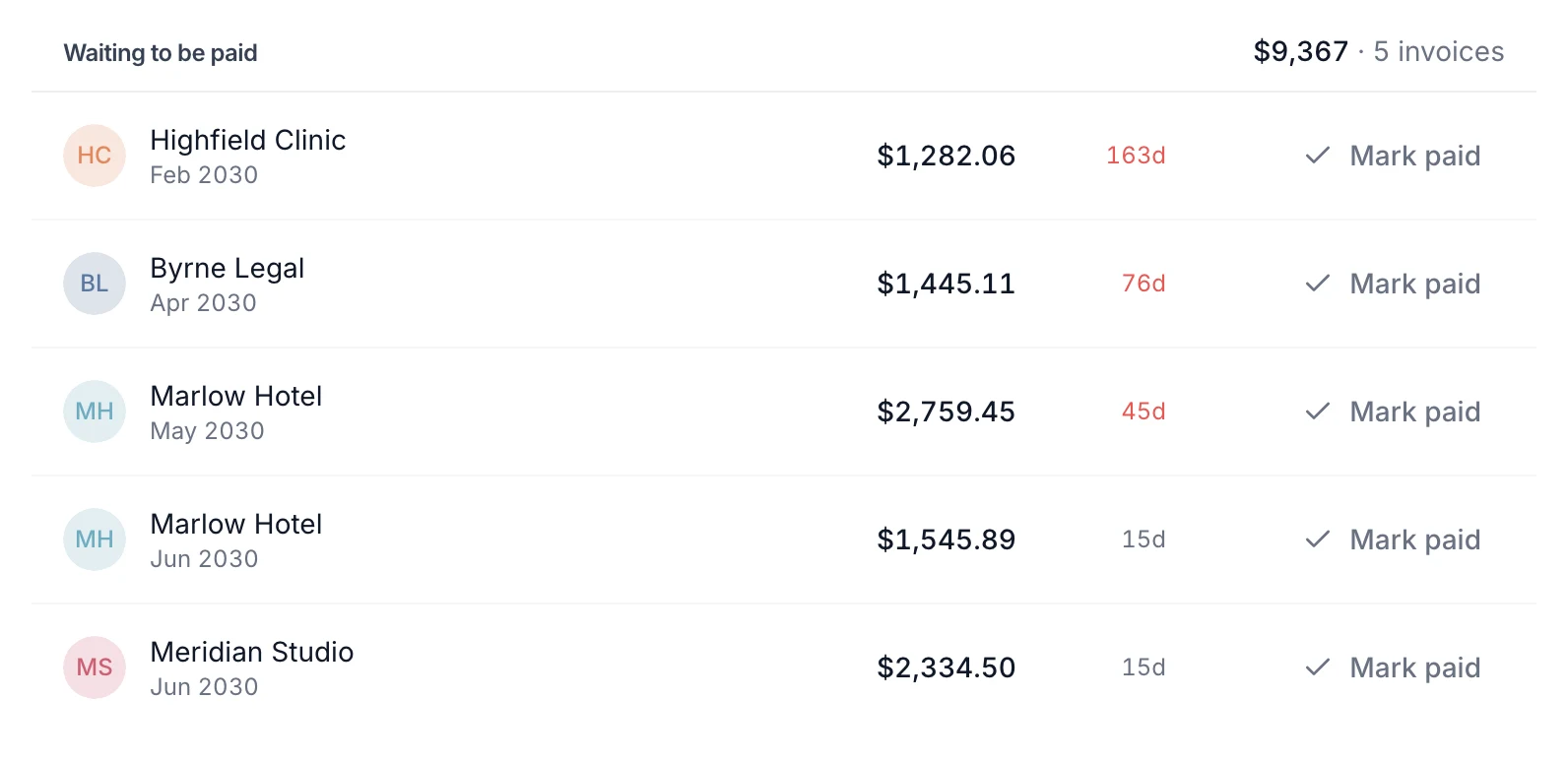
The wording above still does the real work of getting you paid. This part just makes sure you send it on the day it's actually due, not the day you happen to remember.